
History
- The History and Evolution
- The Glider Pilot Regiment's History
- The Record of the Glider Pilot Regiment
The Upward Bound Trust was originally inspired during the year 1961/62 when
Sir Frederick Hoare, Bt. as Lord Mayor of London took as his theme
"Youth and Leadership".
Research as to what positive action
could be taken by the Lord Mayor produced the astonishing fact that
little or nothing was being done to stimulate young people in the
adventure of the air. From that moment the idea to form a gliding
school for young people between the ages of 16 to 21 developed rapidly,
under the guidance of Brigadier George Chatterton, who was working in
the Mansion House for the Lord Mayor at that time. He had commanded the
Glider Pilot Regiment during the Second World War 1939/45. A number of
the glider pilots who had served in the regiment received the idea with
enthusiasm. They formed the nucleus of the instructors of Upward Bound
Trust under the direction of Mr. A. Procter, a member of the regiment
and a qualified instructor. The first Trustees were Sir Frederick
Hoare, Bt., Lady Hoare and Brigadier Chatterton.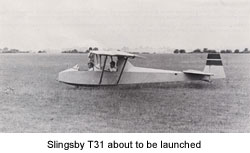
Messrs.
Airtech Ltd. were approached for the use of their airfield at
Haddenham, near Thame, and in 1965 the Upward Bound-Trust was founded
and accepted by the Ministry of Education and Science. The main
principal being to instruct young people between the ages of 16 and 21
to fly gliders, and to obtain their A & B certificates. The
remarkable part of Upward Bound Trust in the early days was that the
staff were all volunteers from the Glider Pilot Regimental Association.
Participating
in this training did not only introduce young men and women to the
adventure of flying, it was considered that training was given in
self-reliance, self-discipline and courage, to say nothing of the
mastering of airmanship, simple air navigation, ground discipline and
maintenance. The added benefits were also that there was considerable
physical effort ranging from walking to lifting and pushing during a
day in the open which lasted from 9.30am until evening. To enable all
types to take part, the Trust itself has deliberately always subsidised
all participants. The cost of this training was £15.00 and remained at
this low level for some time rising to £20.00 in 1973. But, due to its
restricted membership qualifications, was unable to qualify for
government aid, as did most gliding clubs. Fund raising, to enable the
Trust to function, was carried out by Sir Frederick Hoare and Brigadier
Chatterton and others. Additionally, some of the young people were
sponsored further, sometimes by the county education authority,
sometimes by an employer.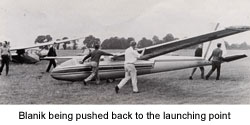
This
was the beginning, but the men of the Glider Pilot Regiment, twenty
years after the last war, taught a large number of young men and women
their own motto - that "Nothing is Impossible". The Upward Bound Trust
was able to come into being through the financial generosity of: - The
Worshipful Company of Goldsmiths - The London Parochial Trust - The
Dulverton Trust - Lloyds. - The Pathfinder Association - RAF.
But
continuance of the Trust was another of its aims, because it carried
out a worthwhile function to society as a whole, so some course pupils
were invited to become 'staff members. Enough of these staff members,
it was hoped, would gain the experience, skill and desire to become
flying instructors themselves, join, and ultimately take over from
instructors whose flying experience started in war conditions.
In
the first ten years of operation the scale of the ground equipment had
improved and consisted of a dual drum diesel powered winch for
launching, two tractors, an engine-less coach used as a launch point
classroom, canteen, restroom and signals base, and a hangar measuring
40 by 60 feet. The flying side was catered for with a T21b, T31b and a
Blanik. Additionally, the Trust also operated a privately owned
Bergfalke II. The Blanik and Bergfalke enabled training and solo flying
in a higher performance machine to take place. However, the majority of
instructors and staff joined together in the early 1970's to buy and
operate a higher performance single-seat glider. The glider chosen was
a Pirat. This relieved the Trust of the expense of providing for the
advanced flying that was necessary to gain sufficient experience to
become an instructor and helped to maintain existing instructor
standards. This in turn enabled the Bergfalke to be replaced by a
second T21b and enabled the Trust to concentrate more on providing
elementary training for ab initios. The Bergfalke continued to be
operated on a private basis. These two gliders, Bergfalke and Pirat, 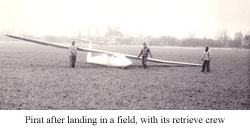 were the first private gliders to be operated at Haddenham along side the Trust.
The
main function of staff was to facilitate the smooth running of courses.
They operated the winch, drove the cable-retrieving tractor, and
maintained the equipment. They flew less than course members did
usually, but sometimes when weather conditions were not right for
initial flying training or when good thermal conditions prevailed, they
were given greater opportunities for flight.
Flying has always
taken place, weather permitting, on Saturdays and Sundays. Though in
winter there is often only flying on Sunday. Pupils attended on either
a Saturday or Sunday when the trust started. Nowadays, the trust runs
the Solo Course on Sundays and the One Day Course on Saturdays. The One
Day Course is only generally run from April until the end of September.
This is to hopefully avoid disappointment due to cancellations due to
the worse weather during the winter months. Each Solo Course pupil has
in the past received and continues to receive 3 - 6 launches each
flying day, thus the course duration is 8 weeks plus as the average
time to solo is 45 to 50 launches. On any one day the total of Solo
Course pupils on the airstrip varies from 4-6 although imminent
examinations, holidays, or other personal reasons can lower the number
on a particular day. The One Day Course is generally 8-10 people and
the Trust likes to concentrate on young people groups, though adult
groups are catered for.
The heaviest costs the Trust have to
bear are fixed annual charges (certificates of airworthiness and
insurance). The weekend only flying and the voluntary nature of the
enterprise limits the utilisation of the gliders and consequently the
flying income. The low price of the Solo Course training is deliberate.
This is subsidised by income from the One Day Course and donations from
Individuals and Business.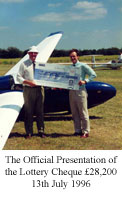
The
Trust has evolved, as many organisations do, and in 1996 applied to the
Lottery Commission for a grant to enable the fleet to be upgraded. This
application was successful and £28,200 was awarded. The Trust used this
money to help purchase two ASK13 gliders. An ASK8 had been purchased
some years before. One of the T21b's was sold and went to Zimbabwe and
the other one was sold to a syndicate and is still based and flown at
Haddenham. The T31 was sold to a syndicate and although for many years
it was based at Dunstable it has now returned to Haddenham. It is known
all over Europe as the "Blue Brick". The other privately owned
Haddenham based gliders are a Sport Vega, Open Cirrus, a Janus CT and
the most recent arrival, an ASK6cr.
Top of the Page
During
the Second World War the first Airborne Units of the British Army were
formed in 1942/3. Among them, was the Glider Pilot Regiment. This
regiment was designed in order that the pilots of the gliders should
not only be fully trained Glider Pilots but also trained soldiers who
would be able to fight on the ground. All were volunteers.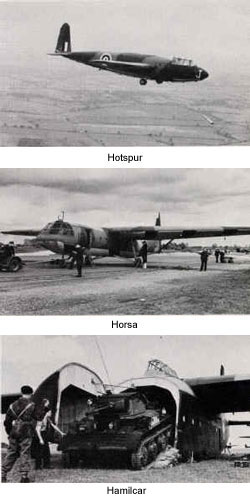 The
Royal Air Force gave these volunteers a full three months elementary
flying course in powered aircraft at several of their flying schools,
and subsequently advanced glider training. At first the Regiment was
developed on the Battalion basis, but later it was changed to Wings and
Squadrons and Flights, as it was based on the airfields of 38 and 46
Groups, RAF.
The
Royal Air Force gave these volunteers a full three months elementary
flying course in powered aircraft at several of their flying schools,
and subsequently advanced glider training. At first the Regiment was
developed on the Battalion basis, but later it was changed to Wings and
Squadrons and Flights, as it was based on the airfields of 38 and 46
Groups, RAF.
The training glider was an 8 seater named the
Hotspur. The operational gliders were the Airspeed Horsa, carrying two
pilots and 28 odd fully equipped soldiers - pay load 6900 Ibs. The
largest, the Hamilcar, had two pilots and carried such loads as tanks,
25 and 17 pounder guns, trucks and Bren-carriers etc. Some 1,800
gliders were landed into operational battles of Europe, and 6,000 tons
of men and equipment were landed in support of the Airborne Divisions.
The gliders were towed by the RAF of 38 and 46 Groups flying bombers
such as the Halifax, Sterling and Albermarle.
The glider pilots
of both Wings fought on the ground in every capacity, suffering 50%
casualties and winning over 170 awards for valour. After the disaster
of Arnhem the casualties of the Glider Pilot Regiment were so great,
over 60%, that officers and NCO Pilots of the Royal Air Force had to be
injected, and these had the distinction of flying, fighting and dying
in the Battle of the Rhine crossing.
The Glider Pilot Regiment
served in Palestine and subsequently flew light aircraft and
helicopters in the Middle and Far East, and with the Air OP Royal
Artillery founded the now distinguished Army Air Corps.
The
Glider Pilot Regimental Association is several hundred strong, and it
is from this that the early instructors of Upward Bound were drawn.
This is a living memorial to the Regiment, in handing on its high
traditions in a practical manner to the coming generations of this
Country.
Top of the Page
The Record
Glider Pilot Regiment
Battle Honours and Overseas Service
1943 -1957
Italy and Sicily
Greece
Yugoslavia
South France
Normandy
Holland
Germany
Palestine
Malaya
Total all ranks taking part in landings
| 409 | Officers |
| 2,893 | Other Ranks |
| 3,302 | Total |
| Total killed, missing, wounded and Prisoner of War - 1,500 |
| Honours and Awards |
| D.S.O. | 3 | American Star | 3 |
| C.M.G. | 1 | Polish Cross | 2 |
| D.C.M. | 7 | Croix de Guere | 4 |
| M.C. | 24 | A.F.C. | 2 |
| D.F.C. | 28 | A.F.M. | 6 |
| M.M. | 31 | M.B.E. | 8 |
| D.F.M. | 52 | B.E.M. | 2 |
| Total Awarded 172 | |||